
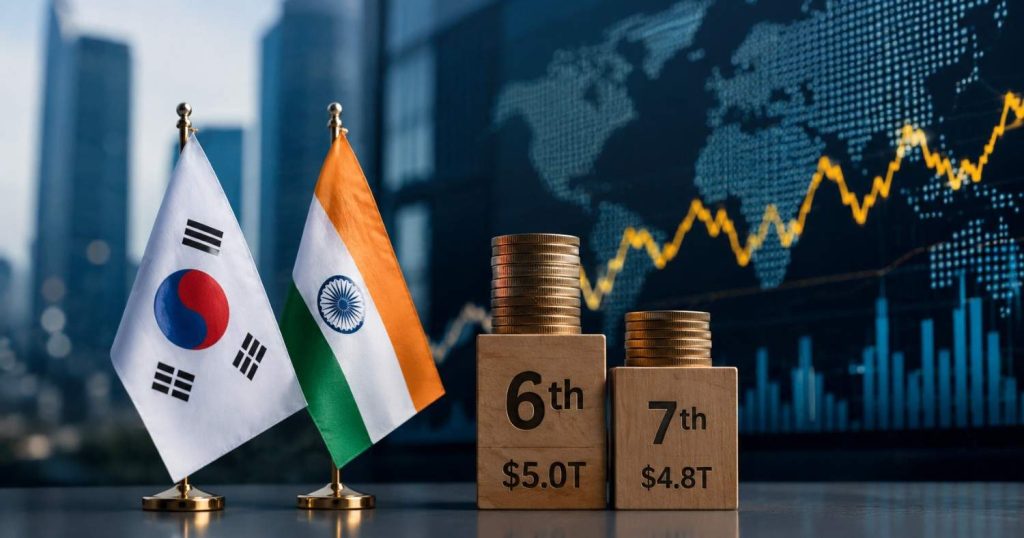
India’s equity markets have slipped to seventh place in the global market capitalization rankings, overtaken by South Korea and, earlier, Taiwan. The development has sparked discussions among investors, economists, and market participants about the evolving dynamics of global capital allocation and the growing influence of artificial intelligence and semiconductor industries on equity valuations.
While India remains one of the world’s fastest-growing major economies, the recent reshuffling highlights how rapidly investor sentiment can shift toward sectors perceived to be at the center of future technological transformation.
Background
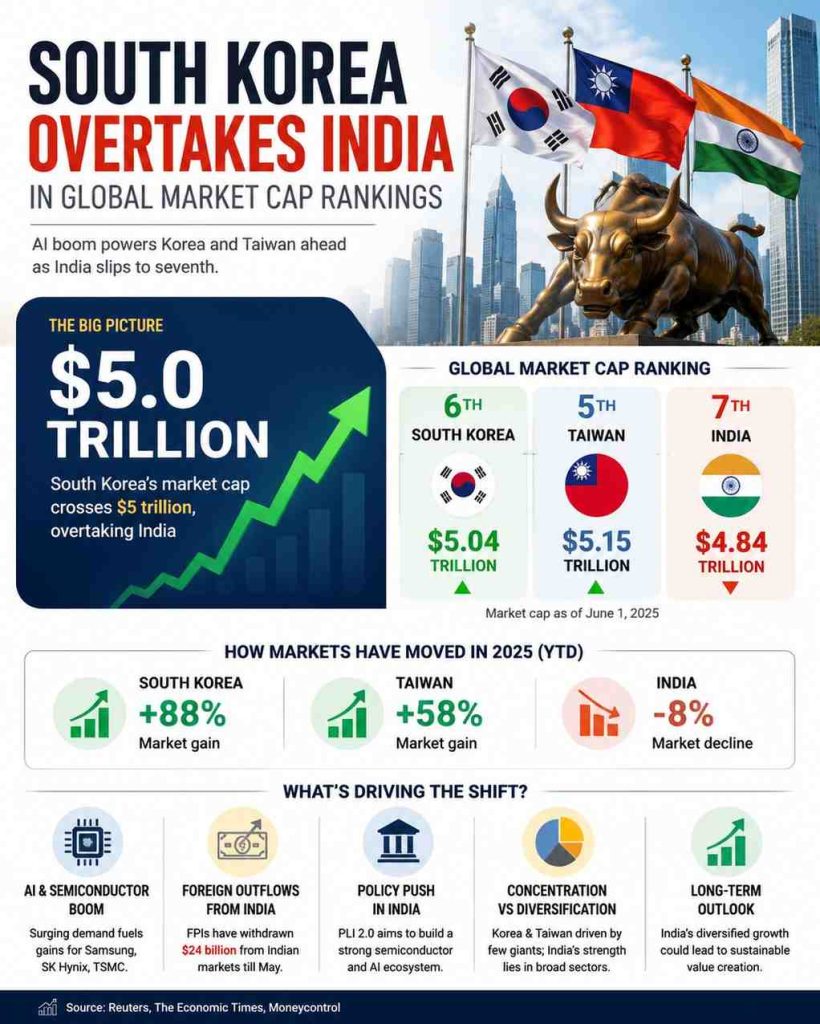
The discussion gained momentum after reports highlighted that South Korea’s total market capitalization crossed $5 trillion, surpassing India’s approximately $4.8 trillion valuation. Taiwan had already moved ahead of India earlier, aided by strong gains in semiconductor-related stocks.
The trend reflects a significant divergence in market performance. Semiconductor leaders such as TSMC, Samsung Electronics, and SK Hynix have benefited from surging global demand for AI infrastructure, data centers, advanced chips, and cloud computing technologies. Meanwhile, India’s equity markets have faced foreign investor outflows, earnings moderation in some sectors, and relatively lower exposure to the AI-driven semiconductor ecosystem.
The development has raised a broader question: Are global investors increasingly favoring economies with dominant positions in AI and semiconductor value chains?
Industry Reactions
According to Robina Das, Executive Manager – Finance at Cummins Technologies India Private Limited, market capitalization rankings often reveal where investors believe future value creation is likely to occur.
“The market capitalization distribution of a country offers a window into where investors believe future value will be created. It reflects where investors see future value creation and, in some cases, where government policy is attempting to build long-term competitive advantages.”
Das noted that Taiwan and South Korea have benefited substantially from the AI and semiconductor boom due to the dominance of companies such as TSMC, Samsung Electronics, and SK Hynix.
“TSMC accounts for nearly 38% of Taiwan’s market cap. Samsung Electronics and SK Hynix together account for almost half of South Korea’s market cap.”
She further highlighted India’s efforts to strengthen its technology manufacturing ecosystem through policy initiatives such as semiconductor-focused incentive programs.
“If this is successful, this policy could help India develop globally competitive technology and semiconductor companies, potentially reshaping the country’s market cap composition over the next decade.”
However, not all experts view India’s lower ranking as a negative development.
Abhinit Kulkarni, who focuses on strategic capital and investment analysis, argued that headline rankings may overlook the advantages of diversification.
“Taiwan’s market cap is heavily concentrated around TSMC. Nearly 38% of the entire market depends on one company. In South Korea, Samsung and SK Hynix together account for almost 46% of the market.”
According to Kulkarni, such concentration can create significant risks when technology cycles reverse or investor sentiment changes.
“This concentration creates extraordinary wealth during euphoric cycles. But it also creates vulnerability when sentiment reverses, technology cycles turn, or global capital reallocates.”
He believes India’s equity market is evolving differently.
“The dependence on top companies is gradually reducing. Market breadth is improving. Capital formation is spreading across manufacturing, financials, defence, EMS, railways, power, chemicals, healthcare, capital goods and digital businesses.”
Kulkarni suggested that broader participation across sectors may ultimately contribute to greater resilience.
“A broad market may look slower during phases of concentrated global tech euphoria. But when the cycle eventually normalizes, diversified participation often matters more than headline market cap rankings.”
What This Means for the Industry
The latest market-cap rankings reveal two competing investment narratives currently shaping global markets.
The first is the AI concentration thesis. Investors are aggressively rewarding companies positioned at the center of AI infrastructure, semiconductor manufacturing, advanced computing, and cloud technology. Countries with dominant technology champions are experiencing substantial valuation expansion as capital seeks exposure to AI-driven growth.
The second is the diversification and resilience thesis. Markets with broader sectoral participation may not generate the same short-term gains during technology booms, but they can potentially offer greater stability across economic cycles.
For India, the development underscores both a challenge and an opportunity. While the country has emerged as a global leader in software services, fintech, and digital public infrastructure, it remains relatively underrepresented in semiconductor manufacturing and advanced hardware ecosystems.
This gap is increasingly important as global investors prioritize exposure to AI-enabling industries.
Future Outlook
The coming decade may determine whether India can translate its policy ambitions into globally competitive semiconductor and deep-tech companies.
Government initiatives aimed at attracting semiconductor fabrication, electronics manufacturing, and AI investments could gradually alter the composition of India’s equity markets. If successful, India may benefit from both technological leadership and sector diversification.
At the same time, experts caution against drawing long-term conclusions from short-term market-cap movements. Technology-driven rallies have historically created periods of extraordinary concentration before eventually normalizing.
The critical question for investors is whether AI-driven demand represents a multi-decade structural transformation or another cyclical technology boom.
Conclusion
South Korea’s rise above India in global market capitalization rankings reflects more than a change in numbers. It highlights the growing influence of AI and semiconductor industries in shaping global investment flows and market leadership.
While Taiwan and South Korea currently benefit from concentrated exposure to some of the world’s most valuable technology companies, India’s strength lies in its increasingly diversified economic and corporate landscape.
The debate is ultimately not about which market is better positioned today, but about which model—concentrated technological dominance or broad-based economic participation—will prove more sustainable in the years ahead.
Key Takeaways
- South Korea has overtaken India to become the world’s sixth-largest equity market by market capitalization.
- Taiwan and South Korea have benefited significantly from the AI and semiconductor boom.
- Companies such as TSMC, Samsung Electronics, and SK Hynix account for a substantial share of their respective markets.
- Experts believe India’s diversified market structure may provide greater long-term resilience.
- India’s semiconductor and AI ambitions could reshape its market composition over the next decade.
- The debate highlights a broader shift in global capital allocation toward AI-linked industries.
About The Author