

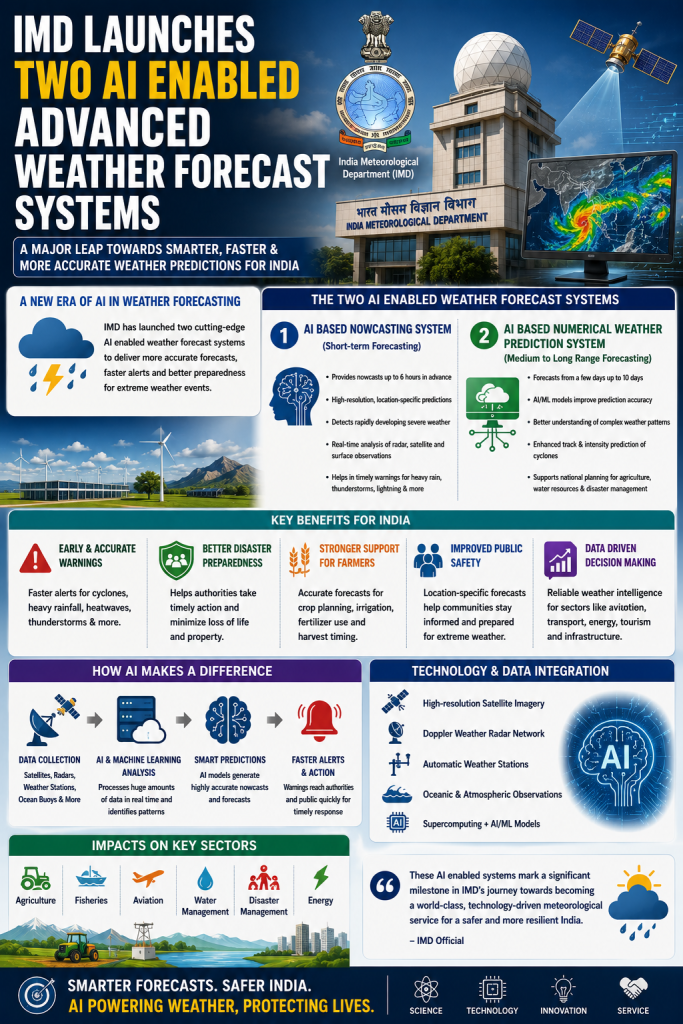
India’s weather forecasting capabilities are set for a major technological leap as the India Meteorological Department has launched two advanced IMD AI weather forecast systems aimed at improving accuracy, speed, and disaster preparedness.
The move marks a significant step toward integrating artificial intelligence into climate monitoring and forecasting. Officials say the new systems will help provide more precise warnings for extreme weather events such as cyclones, heavy rainfall, heatwaves, and thunderstorms.
The launch comes at a crucial time as climate change continues to increase weather unpredictability across India.
What Are the New AI Weather Forecast Systems?
The newly introduced IMD AI weather forecast systems are designed to use artificial intelligence and machine learning technologies to analyze massive volumes of meteorological data in real time.
These systems can reportedly:
- Process satellite and radar data faster
- Improve rainfall prediction accuracy
- Generate quicker weather alerts
- Predict localized extreme weather events
The integration of AI is expected to strengthen India’s ability to respond to rapidly changing weather conditions.
Why the IMD Is Turning to AI
The launch of the IMD AI weather forecast systems reflects growing global reliance on artificial intelligence in climate science.
Traditional forecasting models often require enormous computing resources and longer processing times. AI-based systems can:
- Analyze complex weather patterns rapidly
- Detect anomalies earlier
- Improve short-term forecasting efficiency
Experts believe AI can significantly enhance disaster preparedness, especially in climate-sensitive regions.
Better Forecasting for Cyclones and Heavy Rainfall
One of the key advantages of the IMD AI weather forecast systems is improved prediction of extreme weather events.
India frequently faces:
- Cyclones along coastal regions
- Flash floods during monsoon
- Intense heatwaves in summer
- Severe thunderstorms
Accurate early warnings can help authorities reduce damage, save lives, and improve emergency planning.
Impact on Farmers and Agriculture
The IMD AI weather forecast systems could provide major benefits to India’s agriculture sector.
Farmers rely heavily on weather predictions for:
- Crop planning
- Irrigation schedules
- Fertilizer usage
- Harvest timing
Improved forecasts may help reduce crop losses caused by sudden weather changes.
AI and Climate Change Monitoring
Climate experts say the IMD AI weather forecast systems could also strengthen long-term climate monitoring.
AI tools can help scientists:
- Track temperature shifts
- Analyze rainfall trends
- Study changing monsoon behavior
- Predict climate-related risks more effectively
This data may become increasingly important as global warming intensifies weather instability.
Faster Alerts for Public Safety
The new IMD AI weather forecast systems are expected to improve public warning systems significantly.
Benefits include:
- Faster emergency alerts
- More accurate regional forecasts
- Improved disaster response coordination
Authorities believe this could be especially useful for vulnerable coastal and flood-prone regions.
Technology and Data Integration
The IMD AI weather forecast systems combine multiple sources of meteorological information, including:
- Satellite imaging
- Doppler radar networks
- Oceanic observations
- Historical weather databases
Machine learning models then analyze this information to generate forecasting predictions.
India’s Growing Focus on AI Innovation
The launch of the IMD AI weather forecast systems also reflects India’s broader push toward AI-driven governance and infrastructure.
Artificial intelligence is increasingly being used in sectors such as:
- Healthcare
- Transportation
- Finance
- Agriculture
- Public administration
Weather forecasting is now becoming another major area of AI application.
Experts Welcome the Move
Meteorologists and climate researchers have welcomed the introduction of the IMD AI weather forecast systems.
Experts say:
- Better forecasting improves disaster management
- AI can enhance local weather prediction accuracy
- Early warnings reduce economic losses
However, they also note that continuous data quality improvement will remain essential.
Conclusion
The launch of the IMD AI weather forecast systems marks a major advancement in India’s weather and climate monitoring capabilities. By combining artificial intelligence with meteorological science, IMD aims to deliver faster, smarter, and more accurate forecasts for millions of people across the country.
As climate risks continue to rise, AI-powered forecasting could play a critical role in protecting lives, supporting agriculture, and improving disaster preparedness nationwide.
Also read: Pharma and Banking Outlook: 5 Stocks in Focus Amid Mixed Market Signals
Add Economic Edge as a preferred source on Google- Click Here
About The Author