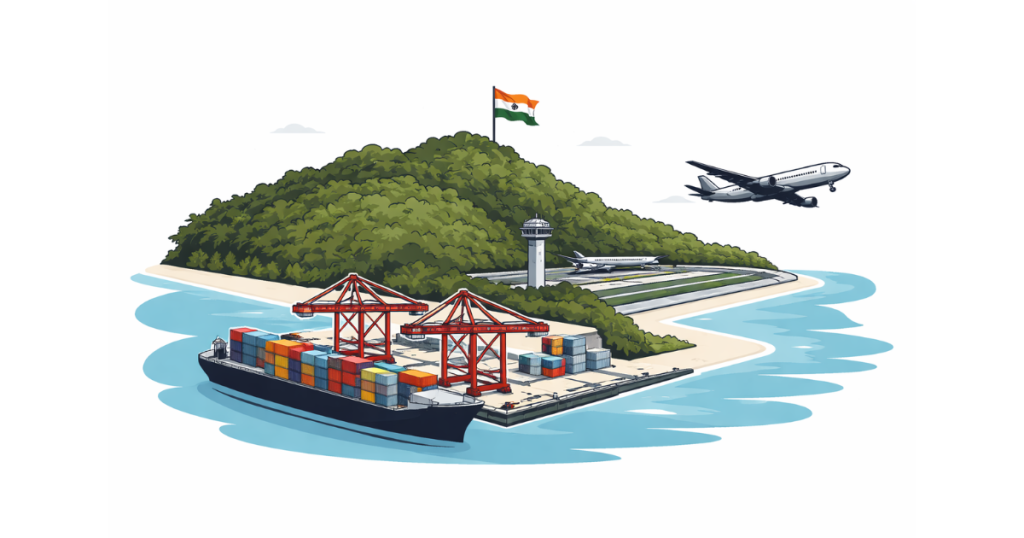
Great Nicobar Island, where India plans to develop a $9 billion transshipment port, airport, and township project after NGT clearance.
The National Green Tribunal has cleared the ambitious Great Nicobar Mega Project, a development plan worth nearly $9 billion that aims to turn India’s southernmost island into a major strategic and economic hub. The decision is significant because the project sits at the intersection of national security, global trade, and environmental protection.
The clearance by the National Green Tribunal follows legal scrutiny of the environmental approval granted in November 2022. The project had faced challenges over concerns related to forest diversion, coastal ecology, and tribal communities.
With the tribunal’s latest decision, the project moves forward under strict environmental conditions. Here is a detailed look at what the Great Nicobar Mega Project includes, why it matters, and what safeguards are in place.
What Is the Great Nicobar Mega Project?
The Great Nicobar Mega Project is a large infrastructure plan proposed on Great Nicobar Island, part of the Andaman and Nicobar Islands.
The project includes the development of:
A transshipment port at Galathea Bay
An international airport
A greenfield township
A power plant and supporting infrastructure
The total estimated investment is around ₹72,000 crore, which is roughly $9 billion.
The transshipment port is expected to handle large container vessels and reduce India’s reliance on foreign ports for cargo transfers. Officials say this will lower logistics costs and improve India’s position in global trade.
Why Is This Project Strategically Important?
Great Nicobar is located close to the Malacca Strait, one of the busiest shipping routes in the world. A major portion of global trade passes through this narrow sea corridor.
India currently depends on ports such as the Port of Singapore for transshipment. Developing a port at Galathea Bay could allow India to capture a larger share of this business.
The island also has strong defence value. It sits at a critical maritime junction in the Indian Ocean Region. A stronger presence in Great Nicobar may improve maritime surveillance and security capabilities.
For policymakers, this project is about long-term strategic positioning, not just commercial gain.
What Did the NGT Decide?
The National Green Tribunal examined petitions challenging the environmental clearance.
Concerns were raised over:
Diversion of forest land
Impact on coastal ecosystems
Threat to wildlife habitats
Risks to indigenous communities
The tribunal upheld the environmental clearance but stressed that all conditions attached to it must be followed strictly. It directed authorities to ensure compliance and monitoring during implementation.
The project has not been struck down. Instead, it must proceed under tighter oversight.
Environmental Concerns Around the Project
Great Nicobar is known for its rich biodiversity and dense tropical forests. The region includes habitats for the Leatherback sea turtle, which nests along parts of the coastline.
Environmental groups have expressed concerns about:
Loss of forest cover
Damage to marine ecosystems
Impact on coral reefs
Disruption to tribal communities
Parts of the island fall under reserved tribal areas. The region is home to vulnerable indigenous groups who have lived there for generations.
Critics argue that large-scale construction could disturb fragile ecosystems. They have called for careful long-term monitoring and transparent implementation.
What Environmental Safeguards Are Promised?
According to official documents, several safeguards have been built into the project.
These include:
Compensatory afforestation for diverted forest land
Wildlife conservation plans
Protection measures for turtle nesting areas
Compliance with Coastal Regulation Zone norms
Monitoring committees to track environmental impact
The NGT has emphasised that compliance with these conditions is mandatory. Periodic reviews and reporting are expected.
The effectiveness of these safeguards will depend on strict enforcement during construction and operation.
Economic Impact and Job Creation
The Great Nicobar Mega Project is expected to generate employment during both construction and operational phases.
Officials believe the port and township could attract international shipping companies and related industries. Improved connectivity may also boost local economic activity in the Andaman and Nicobar Islands.
At present, a significant portion of India’s cargo is transshipped through foreign ports. A domestic transshipment hub could reduce costs for exporters and improve efficiency.
However, long-term economic success will depend on global shipping demand, infrastructure quality, and operational management.
Timeline and Current Status
Environmental clearance was granted in 2022, followed by legal challenges. With the tribunal’s latest order, the project has cleared a key legal hurdle.
Implementation will likely proceed in phases. Large infrastructure projects of this scale typically take several years to complete.
Further approvals and groundwork will be required before full-scale construction begins.
Balancing Development and Ecology
The Great Nicobar Mega Project has sparked a wider debate in India.
Supporters argue that strategic infrastructure is essential for national growth and security. Critics warn that ecological damage in sensitive island ecosystems can be irreversible.
India has made global commitments on climate action and biodiversity protection. Projects in ecologically sensitive regions face heightened scrutiny.
The tribunal’s decision shifts attention to implementation. The key question now is whether development and conservation can move together.
What This Means for India
The clearance of the Great Nicobar Mega Project marks a major step in India’s infrastructure and maritime strategy.
At nearly $9 billion, it is one of the largest development initiatives planned in the Andaman and Nicobar Islands.
The project promises economic gains and strategic advantages. At the same time, it carries environmental responsibilities.
The coming years will determine whether India can execute a mega project in a fragile ecosystem while maintaining strict environmental compliance.
For now, the NGT’s approval gives the government a conditional green signal. The spotlight remains on transparency, safeguards, and long-term sustainability.
Disclaimer: The information presented in this article is intended for general informational purposes only. While every effort is made to ensure accuracy, completeness, and timeliness, data such as prices, market figures, government notifications, weather updates, holiday announcements, and public advisories are subject to change and may vary based on location and official revisions. Readers are strongly encouraged to verify details from relevant official sources before making financial, investment, career, travel, or personal decisions. This publication does not provide financial, investment, legal, or professional advice and shall not be held liable for any losses, damages, or actions taken in reliance on the information provided.
Last Updated on: Tuesday, February 17, 2026 11:12 am by Economic Edge Team | Published by: Economic Edge Team on Tuesday, February 17, 2026 11:12 am | News Categories: India, Business
About The Author