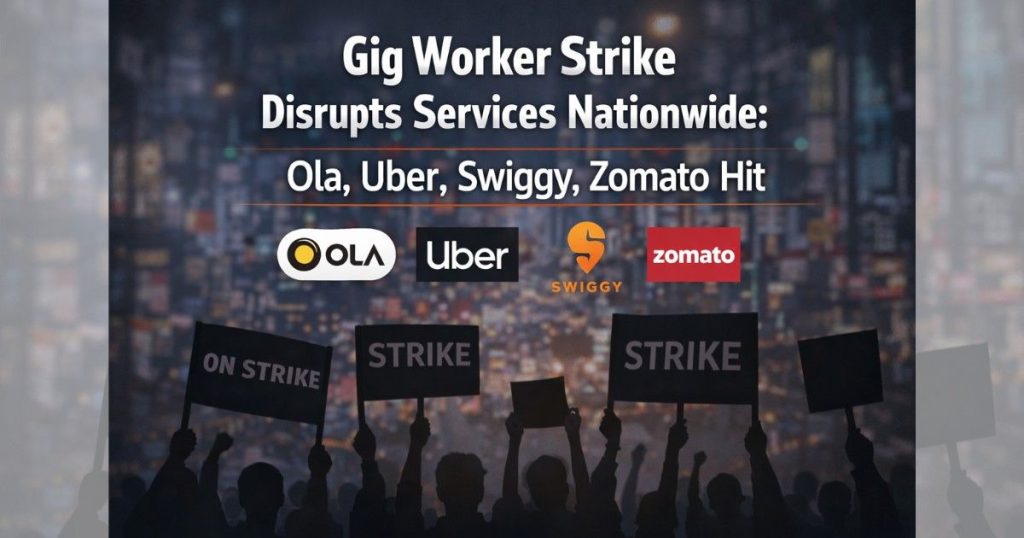
A nationwide strike by gig workers has disrupted ride-hailing and food delivery services across several Indian cities, as drivers and delivery partners working with Ola, Uber, Swiggy, and Zomato protest what they describe as unsustainable earnings. The protest, centred on demands for a minimum fare guarantee, has led to service delays and availability issues, leaving commuters and customers scrambling for alternatives.
The strike has quickly become a trending topic on Google as users seek clarity on the scale of the disruption and its impact on daily travel and food deliveries. Beyond immediate inconvenience, the protest highlights growing tensions within India’s gig economy, where workers say rising fuel costs and falling per-trip earnings have made platform work increasingly difficult to sustain.
What Triggered the Nationwide Gig Worker Strike?
The immediate trigger for the strike was the demand for a minimum fare guarantee, a long-standing issue among drivers and delivery partners. Workers argue that frequent changes in fare structures, reduced incentives, and penalties imposed through app algorithms have led to unpredictable incomes, even as fuel and maintenance costs continue to rise.
Many drivers say they are now earning significantly less per trip compared to previous years, despite longer working hours. Delivery partners have raised similar concerns, claiming that incentive-based pay systems no longer compensate for time, distance, or effort, especially during off-peak hours.
What Is a Minimum Fare Guarantee?
A minimum fare guarantee refers to a fixed base payment per ride or delivery, regardless of demand fluctuations or algorithmic pricing. Gig workers say such a system would ensure a basic level of income, protect them from sudden rate cuts, and provide financial stability in a sector where earnings can vary widely from day to day.
How the Strike Is Affecting Commuters and Customers
The strike led to fewer cabs on the road and limited availability on food delivery apps, particularly during peak hours. Many users reported repeated cancellations, longer wait times, and higher surge pricing as platforms attempted to manage demand with a reduced workforce.
Office-goers, airport travellers, and late-night commuters were among the worst affected, with some forced to rely on public transport or alternative services. Social media platforms were flooded with complaints and queries as customers tried to understand whether services would resume or remain disrupted.
Food Delivery Delays Across Major Cities
Food delivery services were also hit, with several customers reporting delayed orders or unavailability of delivery slots. In some areas, restaurants temporarily paused online orders due to the shortage of delivery partners, further adding to customer inconvenience.
Cities and Regions Most Impacted
Major metropolitan areas including Bengaluru, Delhi-NCR, Mumbai, Chennai, Hyderabad, Pune, and Kolkata saw visible participation in the strike. Bengaluru, often referred to as India’s gig economy hub, witnessed one of the strongest responses, with large numbers of drivers staying offline.
In smaller cities, the impact varied, depending on local coordination among worker groups. While some regions reported partial service availability, others experienced near-complete shutdowns during peak hours.
Gig Workers Speak: ‘Earnings Are No Longer Predictable’
For many gig workers, the protest is about more than fares, it is about dignity and sustainability. Drivers and delivery partners say that constant changes to incentive structures, penalties for cancellations, and opaque algorithms have left them with little control over their income.
Several workers described situations where long hours yielded minimal returns, forcing them to take loans or work extended shifts to cover basic expenses. Many also expressed concern that, despite being labelled “partners,” they have limited bargaining power when policies change.
What Ola, Uber, Swiggy and Zomato Have Said
Platform companies have acknowledged the disruptions and stated that they are monitoring the situation. In past responses to similar protests, companies have maintained that earnings remain competitive and that incentive programs are designed to reward high performance and peak-hour availability.
However, workers’ groups argue that such assurances do not reflect ground realities. As of now, there has been no official confirmation of immediate fare revisions, though discussions between platform representatives and worker associations are expected.
Why This Strike Has National Significance
India is home to millions of gig workers, making it one of the world’s fastest-growing platform-based labour markets. The current strike has renewed debate over whether existing labour laws adequately protect gig workers, who fall outside traditional employment definitions.
The protest also highlights a broader global conversation around platform accountability, worker rights, and the role of technology in shaping labour conditions. Policy experts say the outcome of these protests could influence future regulations governing the gig economy in India.
For commuters and customers, service disruptions may persist in the short term. Authorities have so far not intervened directly, but the scale of the protest could prompt involvement from labour departments if the situation escalates.
The nationwide gig worker strike has laid bare the growing tension between platform companies and the workers who power their services. While customers face immediate inconvenience, the protest raises deeper questions about fair pay, transparency, and sustainability in India’s rapidly expanding gig economy.
Also read: VENUS H-2000 Helmet Series: Advancing Head Protection for Indian Worksites
Add Economic Edge as a preferred source on Google – Click Here
Last Updated on: Saturday, February 7, 2026 3:17 pm by Economic Edge Team | Published by: Economic Edge Team on Saturday, February 7, 2026 3:17 pm | News Categories: Business
About The Author