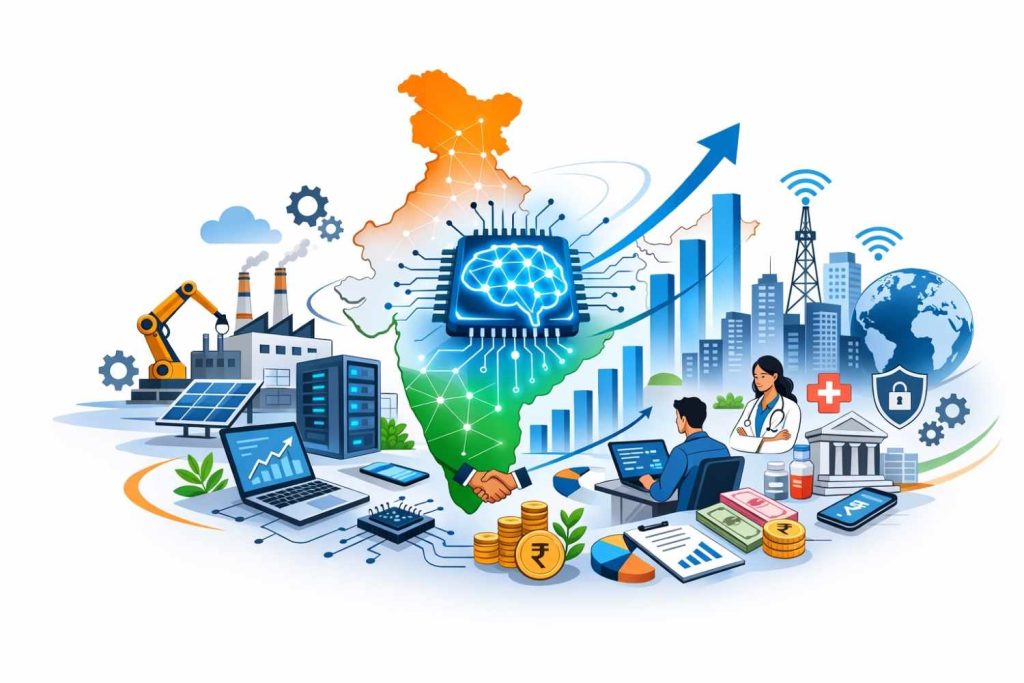
India’s AI economy enters a new growth phase in 2026, driven by tech summits, policy support and rising investments.
India’s artificial intelligence economy is entering a decisive phase in 2026. After years of rapid digitisation, the focus has shifted from pilot projects to large-scale deployment. Government policy, global tech summits and rising private investments are now shaping what many experts call the next digital growth cycle.
From manufacturing to healthcare and agriculture, artificial intelligence is moving from labs to real-world use. For Indian businesses and startups, 2026 is not just about innovation. It is about scale, jobs and global competitiveness.
This matters because India is home to one of the world’s largest digital populations. With over 800 million internet usersand a strong base in IT services, the country is positioning itself as both a major AI market and a global AI talent hub.
AI Economy 2026: From Hype to Implementation
In the past three years, AI discussions in India were largely focused on strategy and adoption. In 2026, the narrative is different. Companies are integrating AI into supply chains, customer service, financial services and product design.
Large IT firms such as Tata Consultancy Services, Infosys, and Wipro have publicly stated that generative AI and automation are central to their client offerings. These firms are training thousands of employees in AI tools and building AI-led solutions for global customers.
At the same time, Indian startups are building AI models for sectors such as fintech, health tech, edtech and agritech. The rise of AI-based chat systems, predictive analytics and automation tools is visible across industries.
The shift is clear. AI is no longer an experimental tool. It is becoming a core business driver.
Government Push: IndiaAI Mission Gains Momentum
The Government of India has placed artificial intelligence at the centre of its digital strategy. The IndiaAI Mission, approved in 2024 with a multi-year financial commitment, aims to build domestic AI capacity, support startups and create computing infrastructure.
In 2026, the focus is on implementation. The mission includes plans for shared computing facilities, AI datasets, skill development programmes and support for research institutions.
The Ministry of Electronics and Information Technology has also encouraged public-private partnerships to accelerate AI adoption. States such as Karnataka, Telangana and Tamil Nadu are actively promoting AI hubs and innovation parks.
India’s policy approach is focused on three areas: infrastructure, talent and responsible AI use. This balanced approach is seen as critical in a fast-moving global AI race.
Tech Summits 2026: India’s AI Ambition on Display
Major technology conferences in 2026 have become platforms for AI announcements and investment commitments. Global and domestic players are using these events to unveil new AI centres, research labs and startup funds.
Summits in cities like Bengaluru, Hyderabad and New Delhi are drawing participation from multinational firms, venture capital funds and policymakers. Discussions are centred on AI governance, chip manufacturing, cloud infrastructure and industry applications.
These events are not just symbolic. They are deal-making platforms. Investment announcements made during tech summits often lead to job creation and new development centres in India.
India’s growing role in global supply chains, especially in digital services, is also being highlighted in international AI forums.
Foreign Investment and Big Tech Expansion
Global technology companies continue to expand their AI presence in India. Cloud giants such as Google, Microsoft, and Amazon Web Services are increasing data centre investments to support AI workloads.
India’s large developer base and cost advantage make it attractive for AI research and engineering work. In 2026, many global firms are setting up AI labs focused on natural language processing, computer vision and automation.
Foreign direct investment in the digital and technology sector remains strong. While exact figures vary year to year, technology services and digital infrastructure consistently rank among the top sectors for foreign inflows.
Private equity and venture capital firms are also backing AI-focused startups. Funding activity shows investor confidence in India’s long-term digital growth story.
AI and Employment: Skill Shift, Not Job Loss
A major concern around AI is job displacement. However, industry leaders in India are framing 2026 as a year of skill transition rather than job loss.
Large IT companies are retraining employees in AI tools and automation platforms. Engineering graduates are increasingly learning data science, machine learning and prompt engineering.
Government-backed skilling programmes are also focusing on AI and emerging technologies. Universities and private training institutes are expanding AI-related courses.
The demand is rising for roles such as AI engineers, data analysts, AI ethics specialists and cloud architects. While routine tasks may be automated, new job categories are emerging.
For India, which produces millions of graduates each year, aligning education with AI-driven industry needs is now a national priority.
Sector Impact: From Agriculture to Healthcare
The AI economy in India is not limited to software exports. Domestic applications are expanding.
In agriculture, AI tools are being used for crop monitoring, yield prediction and disease detection. Startups are building image-based systems that help farmers identify plant health issues using smartphones.
In healthcare, AI systems assist doctors in medical imaging, diagnostics and hospital management. AI-driven chatbots are being used for patient support and appointment scheduling.
In financial services, banks and fintech firms are deploying AI for fraud detection, risk assessment and personalised services.
Manufacturing units are adopting AI-based quality control systems and predictive maintenance tools. Retail companies are using AI for inventory planning and customer analytics.
This wide sector adoption strengthens the AI economy beyond the IT services industry.
Semiconductors and Infrastructure: The Next Frontier
For AI to grow at scale, computing power is essential. India is pushing semiconductor manufacturing and advanced computing infrastructure as part of its broader technology strategy.
The government’s semiconductor incentive schemes aim to attract chip manufacturing and design units. While India is still building its fabrication ecosystem, design and research activity is expanding.
Data centres are also growing rapidly. AI applications require high-performance computing and cloud capacity. India’s rising data consumption supports this demand.
Building strong digital infrastructure is key to sustaining AI growth in the coming decade.
Responsible AI and Regulation in Focus
As AI systems become more powerful, concerns about data privacy, bias and misinformation are rising. Policymakers in India are discussing frameworks for responsible AI use.
India’s digital policy approach balances innovation with safeguards. Industry bodies and think tanks are working on ethical guidelines and transparency standards.
In 2026, debates around AI regulation are becoming more visible. Companies are investing in compliance and governance systems to ensure safe deployment.
Responsible AI is not just a legal issue. It is also a business requirement, especially for global clients.
Global Context: India in the AI Race
Countries such as the United States, China and members of the European Union are investing heavily in artificial intelligence. India’s strategy is different. It focuses on talent, software strength and scalable digital infrastructure.
India’s IT exports, which already contribute significantly to the economy, are expected to benefit from AI-led services. AI integration into outsourcing and consulting services gives India a competitive edge.
At the same time, domestic demand from small and medium enterprises is increasing. Affordable AI tools are enabling businesses to improve efficiency without large capital investments.
India’s demographic advantage and digital adoption rate provide a strong foundation for long-term AI growth.
What 2026 Means for Businesses and Consumers
For businesses, 2026 is a year of strategic decision-making. Companies that adopt AI effectively can improve productivity and reduce costs.
For consumers, AI is becoming part of daily life. From voice assistants to personalised recommendations and digital payments, AI-powered services are already widely used.
The next phase will see deeper integration across public services, education platforms and digital governance systems.
The AI economy is no longer a future promise. It is shaping India’s present growth path.
The Road Ahead
India’s AI economy in 2026 stands at a critical point. Policy support, global investment, tech summits and industry adoption are aligning in a rare moment of opportunity.
Challenges remain. Infrastructure gaps, skill mismatches and regulatory clarity will require sustained effort.
However, the direction is clear. Artificial intelligence is moving from a technology trend to a core economic engine.
As India positions itself for the next decade of digital growth, the AI economy is set to play a defining role in shaping jobs, innovation and global competitiveness.
Disclaimer: The information presented in this article is intended for general informational purposes only. While every effort is made to ensure accuracy, completeness, and timeliness, data such as prices, market figures, government notifications, weather updates, holiday announcements, and public advisories are subject to change and may vary based on location and official revisions. Readers are strongly encouraged to verify details from relevant official sources before making financial, investment, career, travel, or personal decisions. This publication does not provide financial, investment, legal, or professional advice and shall not be held liable for any losses, damages, or actions taken in reliance on the information provided.
edited by D Rishidhar Reddy
About The Author