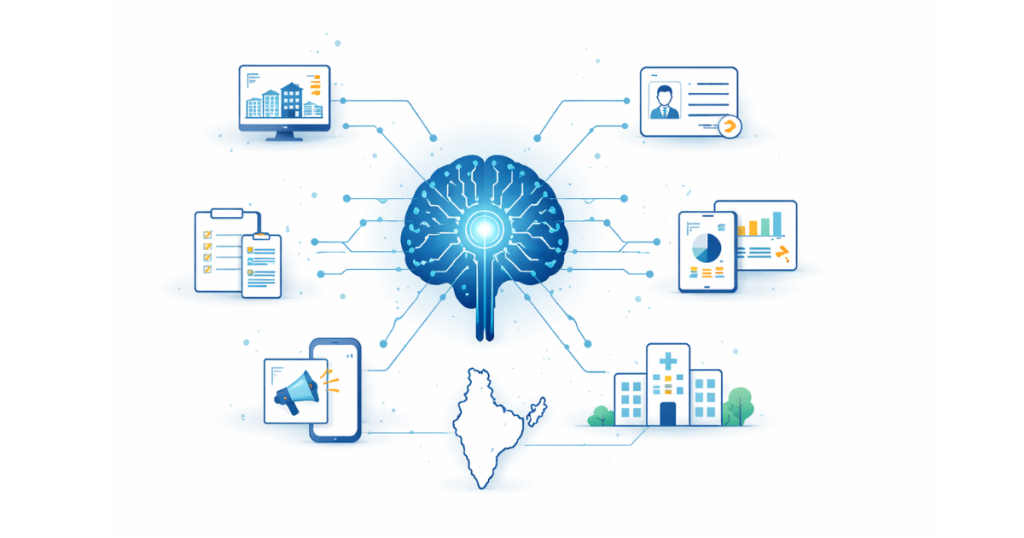
Bharat-VISTAAR aims to use artificial intelligence to modernise digital governance and improve public service delivery across India.
India is taking another major step in its digital journey with the launch of Bharat-VISTAAR, a new artificial intelligence-driven initiative aimed at improving governance and public service delivery.
At a time when India is rapidly expanding digital infrastructure under programmes such as Digital India and strengthening data platforms like India Stack, Bharat-VISTAAR is being positioned as the next layer of innovation. It aims to use AI tools to make government systems smarter, faster and more citizen-friendly.
The initiative is expected to support ministries, state governments and public departments by helping them analyse large volumes of data, automate routine processes and improve decision-making. As India pushes toward becoming a global digital leader, Bharat-VISTAAR could become a key pillar in modernising governance.
Here is a detailed look at what Bharat-VISTAAR is, why it matters and how it could reshape digital public services.
What is Bharat-VISTAAR?
Bharat-VISTAAR is described as an AI-powered governance framework designed to strengthen digital public infrastructure in India. The name signals its focus on expansion and transformation across sectors.
The initiative aims to integrate artificial intelligence tools into existing government platforms. These tools can help departments process applications, track welfare schemes, analyse trends and improve service delivery.
Unlike standalone tech projects, Bharat-VISTAAR is designed to work across multiple ministries and states. It seeks to create a unified ecosystem where data and AI systems can support each other in real time.
The focus is not only on automation. The initiative also aims to improve transparency, reduce delays and make services more accessible to citizens across urban and rural India.
Why Bharat-VISTAAR Matters Now
India has one of the world’s largest digital user bases. With over 1.4 billion people, the scale of governance is massive. Millions of applications for subsidies, certificates, benefits and services are processed every day.
While platforms under Digital India have already improved access, challenges remain. Delays, manual verification and data silos can slow down processes.
Bharat-VISTAAR comes at a time when governments globally are exploring AI for governance. For India, the move signals a shift from digitisation to intelligent governance.
It also aligns with India’s broader push toward responsible and inclusive AI development. Policymakers have repeatedly stressed that AI must be safe, ethical and citizen-centric.
How AI Will Be Used in Governance
Bharat-VISTAAR is expected to use AI in several practical ways within public administration.
One key area is automated processing of applications. AI systems can quickly scan documents, verify details and flag errors. This can reduce waiting time for services such as licences, certificates and benefit approvals.
Another area is predictive analysis. By analysing historical data, AI can help governments identify areas where welfare schemes are underperforming. It can also help detect fraud or unusual patterns in public spending.
Chat-based digital assistants may also become part of citizen service portals. These AI tools can answer common questions in multiple Indian languages, making services more inclusive.
Data analytics under Bharat-VISTAAR could also help policymakers make faster decisions during emergencies. For example, real-time data analysis can support disaster response or health monitoring systems.
Impact on Public Services
The most visible impact of Bharat-VISTAAR is likely to be in everyday services used by citizens.
If implemented effectively, citizens could experience faster approvals, fewer visits to government offices and more accurate information online.
For rural users, language support powered by AI can improve access. India’s digital platforms already support multiple languages, but AI-based translation and voice tools can further expand reach.
Healthcare and education are two sectors where AI-backed analytics can improve planning. Governments can use data insights to allocate resources more efficiently and track outcomes more closely.
Urban services such as traffic management, utility monitoring and grievance redressal systems may also benefit from smarter data tools.
Boost to Transparency and Accountability
Digital systems create digital trails. When combined with AI, they can also highlight inefficiencies and anomalies.
Bharat-VISTAAR could help monitor service delivery timelines. Departments that consistently delay responses may be identified through data analysis.
Similarly, AI can detect patterns that suggest misuse of funds or duplication of benefits. While human oversight remains essential, AI can act as an early warning system.
This can improve accountability and strengthen public trust in government systems.
Integration With Existing Digital Infrastructure
India already has a strong digital foundation. Platforms built under Digital India and India Stack support identity verification, payments and document storage.
Bharat-VISTAAR is expected to integrate with these systems rather than replace them.
For example, AI tools could analyse transaction patterns on government payment platforms to detect errors or inefficiencies. Document verification systems may become faster with AI-based checks.
By building on existing infrastructure, the initiative aims to reduce duplication and ensure smoother adoption.
Focus on Data Security and Responsible AI
As AI systems handle sensitive public data, concerns around privacy and security are central.
Officials have repeatedly emphasised that AI tools used in governance must follow strict data protection standards. Data must be handled responsibly and transparently.
India is also working on strengthening its data protection framework. Any AI-driven initiative must align with national laws and global best practices.
Responsible AI practices may include regular audits, bias testing and human review mechanisms. This ensures that automated decisions do not unfairly impact citizens.
Challenges Ahead
While the promise of Bharat-VISTAAR is significant, implementation will not be simple.
Government departments vary widely in their digital maturity. Some states have advanced systems, while others may need upgrades before integrating AI tools.
Training government officials is another key factor. AI systems are only effective when users understand how to use and monitor them properly.
Infrastructure gaps in remote areas may also limit the speed of rollout. Reliable internet access and secure data storage are essential for AI-driven governance.
Experts also caution that AI should assist, not replace, human judgement in public administration.
What It Means for Citizens
For citizens, the impact of Bharat-VISTAAR will likely be felt gradually.
Over time, government websites and mobile apps may become more responsive. Application tracking systems could offer real-time updates.
Grievance redressal platforms may respond faster with AI-assisted triaging of complaints.
If language and voice tools are integrated effectively, people who are not comfortable with English or typing could access services more easily.
The long-term goal appears to be simple: reduce friction between citizens and the state.
India’s Broader AI Ambition
Bharat-VISTAAR is part of a larger national conversation about AI and digital growth.
India has positioned itself as a key player in global technology. The country is investing in AI research, digital public infrastructure and startup ecosystems.
By applying AI to governance, India signals that public systems can also benefit from innovation.
This approach could strengthen India’s image as a leader in digital public goods. Countries around the world are studying India’s digital models, especially identity and payment platforms.
If Bharat-VISTAAR delivers measurable improvements, it could become another example of scalable digital governance.
The Road Ahead
The success of Bharat-VISTAAR will depend on careful rollout, strong oversight and clear communication with citizens.
Transparency about how AI systems work will be critical. Citizens must understand how their data is used and how decisions are made.
Collaboration between central and state governments will also be key. Uniform standards can help ensure consistent service quality across regions.
India’s digital journey began with connectivity and identity systems. It then expanded into payments and public services. With Bharat-VISTAAR, the next phase appears to focus on intelligent governance.
For a country of India’s scale, even small improvements in efficiency can impact millions of lives.
As AI becomes part of everyday governance, the real measure of success will be simple: faster services, fairer systems and stronger public trust.
Bharat-VISTAAR could mark a major step in that direction.
Disclaimer: The information presented in this article is intended for general informational purposes only. While every effort is made to ensure accuracy, completeness, and timeliness, data such as prices, market figures, government notifications, weather updates, holiday announcements, and public advisories are subject to change and may vary based on location and official revisions. Readers are strongly encouraged to verify details from relevant official sources before making financial, investment, career, travel, or personal decisions. This publication does not provide financial, investment, legal, or professional advice and shall not be held liable for any losses, damages, or actions taken in reliance on the information provided.
Financial Disclaimer: Markets and investment-related products are subject to risks and fluctuations. Readers should conduct their own research and consider consulting a qualified financial advisor before making any investment decisions.
Last Updated on: Tuesday, February 17, 2026 11:39 am by Economic Edge Team | Published by: Economic Edge Team on Tuesday, February 17, 2026 11:39 am | News Categories: India, Business
About The Author