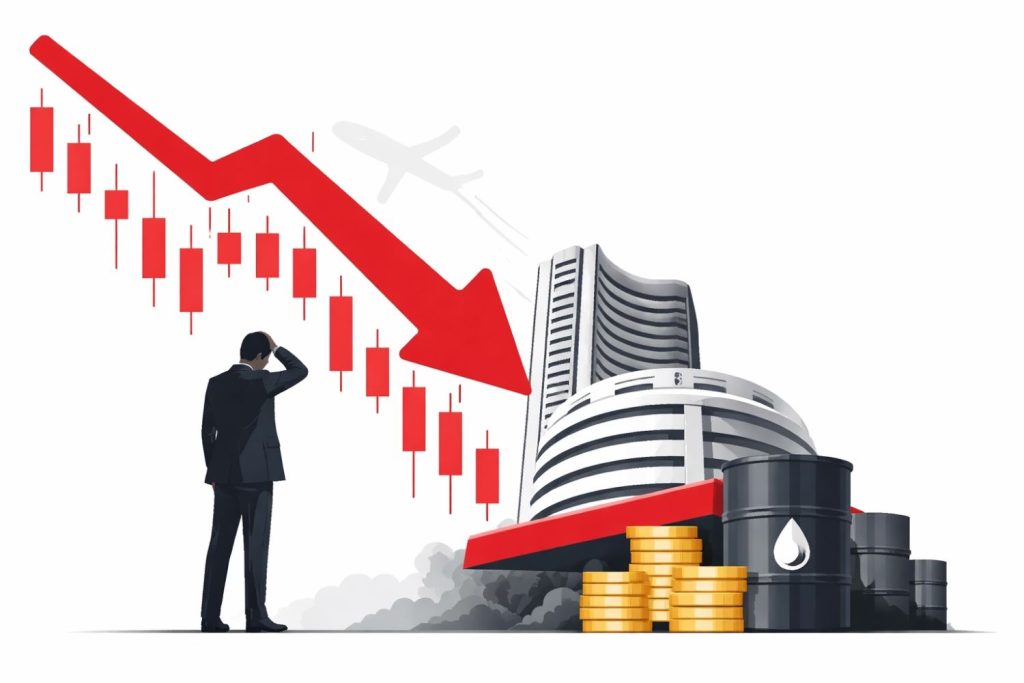
Sensex plunges over 2,000 points while Nifty falls below 24,000 as global market weakness and rising crude oil prices trigger heavy selling in Indian equities.
India’s stock markets witnessed a sharp sell-off on Monday as global market weakness and rising crude oil prices triggered panic among investors. The benchmark BSE Sensex plunged more than 2,000 points, while the NSE Nifty 50 slipped below the key 24,000 level, marking one of the biggest single-day declines in recent months.
The sudden fall reflects growing worries about global economic uncertainty, rising energy costs, and continued foreign investor outflows. Market analysts say the correction was driven by a mix of international and domestic triggers, including pressure in global equity markets, oil price volatility, and profit booking after the recent rally in Indian stocks.
For investors across India, the sharp decline is a reminder that global developments can quickly impact domestic markets.
Stock Markets Open Deep in the Red
Indian equity benchmarks started the trading session on a weak note and losses intensified as the day progressed.
By mid-session, the BSE Sensex dropped over 2,000 points, while the NSE Nifty 50 slipped below 24,000. Several heavyweight stocks saw heavy selling pressure.
The sell-off wiped out significant market value from investor portfolios within hours. Large-cap banking, IT, and energy stocks led the decline, dragging the broader market lower.
Market participants said the fall was largely triggered by negative global cues and concerns about rising inflation due to higher crude oil prices.
Global Market Weakness Triggers Selling
The sharp fall in Indian markets followed declines in several global indices.
Asian markets traded lower as investors reacted to concerns about slower global economic growth, continued geopolitical tensions affecting oil supply, and weak cues from major Western markets.
When global markets show risk aversion, foreign investors often reduce exposure to emerging markets such as India. This can lead to sudden outflows from equities.
Analysts noted that the sell-off in global markets created a ripple effect, prompting investors to cut positions in Indian stocks as well.
Oil Price Surge Adds to Market Anxiety
Another key factor behind the market fall was the sharp rise in crude oil prices.
Higher crude prices create multiple challenges for India because the country imports a large share of its energy needs.
When oil prices rise, India’s import bill increases, inflation risks grow, government fiscal pressure may rise, and corporate profit margins can shrink.
These concerns often lead investors to reassess growth expectations for the economy.
Energy-intensive sectors such as aviation, logistics, and manufacturing are particularly sensitive to rising fuel costs.
Nifty Falls Below the Key 24,000 Level
The drop in the Nifty 50 below 24,000 is being closely watched by market participants.
This level had been acting as an important psychological and technical support for traders.
Breaking below this level may trigger increased short-term volatility and technical selling. It can also make investor sentiment more cautious.
However, many analysts believe the current fall could represent a healthy correction after the strong rally seen earlier in the year.
Indian markets had been trading near record highs in recent weeks before the sudden pullback.
Banking and IT Stocks Lead the Decline
Heavyweight sectors played a major role in dragging the markets lower.
Banking Stocks Under Pressure
Banking stocks, which carry significant weight in the indices, saw strong selling.
Investors often reduce exposure to financial stocks during uncertain periods because they are closely linked to economic growth expectations.
Private sector lenders and large public sector banks both faced declines during the session.
IT Sector Tracks Global Tech Weakness
The information technology sector also slipped, reflecting weak global tech sentiment.
Indian IT companies depend heavily on demand from the United States and Europe. When global economic uncertainty rises, spending on technology services can slow down.
This makes IT stocks sensitive to global market movements.
Foreign Investors Continue to Sell
Foreign institutional investors remain an important driver of Indian equity markets.
In recent sessions, FIIs have been reducing exposure to emerging markets, including India.
Reasons behind the selling include higher global interest rates, strength in the US dollar, and broader risk-off sentiment in global markets.
When foreign investors pull money out of equities, it often results in sharp intraday market swings.
Domestic institutional investors and retail investors have helped cushion some of the impact, but heavy foreign selling can still move markets significantly.
Market Volatility Returns After Record Highs
The recent fall comes after Indian markets had been enjoying a strong rally.
Over the past year, the Sensex and Nifty have repeatedly touched new record highs, supported by strong domestic economic growth, robust corporate earnings, increased retail investor participation, and a positive long-term outlook for India.
However, experts often warn that periodic corrections are normal in a rising market cycle.
Short-term volatility can occur when global events or macroeconomic changes affect investor sentiment.
Impact on Retail Investors
The sudden market decline has affected millions of retail investors across India.
In recent years, more Indians have entered the stock market through direct equity investments, mutual funds, and systematic investment plans.
For long-term investors, analysts say short-term corrections should be viewed cautiously but not with panic.
Market experts generally advise investors to avoid emotional selling during volatility, focus on long-term investment goals, and maintain diversified portfolios.
Retail investors are increasingly becoming a stabilizing force in Indian markets, often buying during dips.
What Experts Are Watching Next
Market participants are now closely tracking several global and domestic indicators.
Crude oil prices remain a key concern. If prices continue rising, inflation risks may increase and markets could remain under pressure.
Global interest rate signals from major central banks are also important, as they influence capital flows and investor sentiment.
Foreign investor activity will be closely monitored because sustained outflows can keep volatility elevated.
Corporate earnings outlook will also play a crucial role. Strong earnings from Indian companies could help markets regain stability.
India’s Economic Fundamentals Remain Strong
Despite the sharp fall in equities, many economists maintain that India’s long-term economic outlook remains stable.
India continues to benefit from strong domestic consumption, government infrastructure spending, an expanding manufacturing sector, and a rapidly growing digital economy.
These structural factors continue to attract global investors to Indian markets over the long term.
Short-term market declines often occur even during strong economic cycles.
Outlook: Volatility Likely in the Near Term
Market experts believe volatility may continue in the coming days as investors react to global developments and energy price trends.
However, the broader outlook for Indian equities remains tied to economic growth, corporate earnings performance, and global financial conditions.
Investors are advised to stay cautious but avoid making decisions based purely on short-term market swings.
As the trading week progresses, market participants will watch whether the Sensex and Nifty can stabilize after the sharp fall.
For now, the 2,000-point drop in the Sensex and the Nifty’s slide below 24,000 serve as a reminder that global shocks can quickly ripple through India’s financial markets.
Disclaimer: The information presented in this article is intended for general informational purposes only. While every effort is made to ensure accuracy, completeness, and timeliness, data such as prices, market figures, government notifications, weather updates, holiday announcements, and public advisories are subject to change and may vary based on location and official revisions. Readers are strongly encouraged to verify details from relevant official sources before making financial, investment, career, travel, or personal decisions. This publication does not provide financial, investment, legal, or professional advice and shall not be held liable for any losses, damages, or actions taken in reliance on the information provided.
Financial Disclaimer: Markets and investment-related products are subject to risks and fluctuations. Readers should conduct their own research and consider consulting a qualified financial advisor before making any investment decisions.
edited by D Rishidhar Reddy
Last Updated on: Monday, March 9, 2026 11:07 am by Economic Edge Team | Published by: Economic Edge Team on Monday, March 9, 2026 11:07 am | News Categories: Business
About The Author