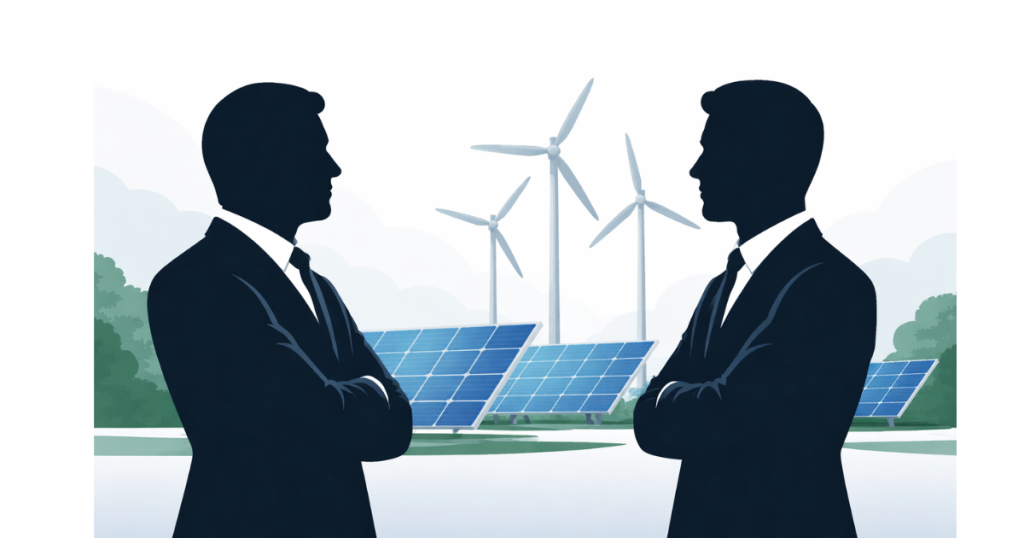
Reliance and Tata intensify competition in India’s renewable energy sector, focusing on solar manufacturing, green hydrogen, and clean power expansion in 2026.
India’s clean energy race has entered a decisive phase in 2026, with two corporate giants — Reliance and Tata Group — intensifying their push for leadership in the country’s fast-growing green energy sector.
As India moves closer to its 2030 renewable energy targets and long-term net-zero goals, the battle between these two business houses is shaping the future of solar, hydrogen, storage, and green manufacturing.
For investors, policymakers, and consumers, this is more than a corporate rivalry. It is about who will power India’s energy transition in the next decade.
Why the Reliance vs Tata Green Energy Battle Matters in 2026
India has committed to installing 500 GW of non-fossil fuel capacity by 2030. The country is also targeting net-zero emissions by 2070. These goals require massive private sector investment.
The green energy market is expected to attract billions of dollars in capital expenditure over the next few years. Large-scale solar parks, green hydrogen hubs, battery storage plants, and EV infrastructure are expanding rapidly.
In this high-stakes environment, Reliance and Tata have emerged as the two most aggressive players.
Reliance’s Green Energy Push: Big Bets and Massive Investments
Reliance Industries Limited, led by Mukesh Ambani, has made clean energy one of its core growth pillars.
In recent years, Reliance announced multi-billion-dollar investments in renewable energy and green hydrogen. The company is building an integrated renewable energy ecosystem that includes:
Solar module manufacturing
Energy storage systems
Green hydrogen production
Electrolyzer manufacturing
Advanced battery technology
Reliance has set up large manufacturing plans in Gujarat, aiming to create one of the world’s largest clean energy hubs. The company has repeatedly stated that it wants to become a global leader in green hydrogen.
Focus on Green Hydrogen
Green hydrogen is seen as a major future fuel. It is produced using renewable energy and does not emit carbon during production.
Reliance is positioning itself as a cost leader in this space. The company has said it aims to bring down hydrogen production costs to globally competitive levels.
If successful, this could reshape India’s industrial fuel market.
Backward Integration Strategy
Reliance is following a strategy similar to what it used in telecom and petrochemicals — full control over the value chain.
By manufacturing solar panels, storage systems, and hydrogen equipment in-house, the company aims to reduce dependency on imports and improve margins.
Tata Group’s Clean Energy Strength: A Steady and Expanding Portfolio
On the other side, Tata Group has been building its renewable business for years through its listed arm Tata Power.
Unlike Reliance, which entered the sector aggressively in recent years, Tata already has a strong presence in:
Solar generation
Rooftop solar installations
EV charging networks
Wind energy
Power distribution
Tata Power has been expanding its renewable portfolio steadily. The company is also focused on residential rooftop solar solutions and electric vehicle infrastructure.
Leadership in Rooftop Solar
Tata Power is among the leaders in India’s rooftop solar segment. With government support for residential solar and net metering, this market is growing quickly.
Rooftop solar is important because it reduces load on the grid and supports distributed energy systems.
EV Ecosystem Advantage
The Tata Group also benefits from its presence in electric vehicles through Tata Motors.
As EV adoption rises, the demand for charging infrastructure and clean electricity increases. Tata’s integrated approach across power and mobility gives it an ecosystem advantage.
Solar Manufacturing: A Key Battleground
India is pushing to reduce dependence on imported solar modules. Government policies now encourage domestic manufacturing through production-linked incentives.
Both Reliance and Tata are expanding manufacturing capacity.
Reliance is building fully integrated giga-scale facilities. Tata is expanding its solar manufacturing through Tata Power and associated ventures.
The winner in this segment will likely be the company that achieves scale faster while keeping costs low.
Green Hydrogen: The Long-Term Decider
The Government of India has launched a National Green Hydrogen Mission. The aim is to make India a global hub for green hydrogen production and export.
Reliance appears more aggressive in hydrogen investments. However, Tata has also shown interest in industrial decarbonisation and clean energy solutions.
Green hydrogen will require massive renewable capacity, water resources, and storage infrastructure. The company that integrates these components efficiently could gain long-term dominance.
Capital Strength and Funding Power
Reliance has one of the strongest balance sheets in the country. Its ability to raise capital quickly is a major advantage.
Tata Group also has strong institutional credibility and long-term investor trust.
The competition is not just about projects. It is about execution speed, technology partnerships, and access to global markets.
Policy Support and Regulatory Environment
India’s clean energy transition depends heavily on government policy.
In recent years, policies have focused on:
Domestic solar manufacturing
Green hydrogen incentives
Battery storage development
Grid modernisation
Electric vehicle adoption
Both Reliance and Tata are aligning their strategies with national priorities.
State governments are also competing to attract green investments, offering land and policy support.
Stock Market and Investor Interest in 2026
Green energy stocks remain in focus in 2026 as investors track capacity additions and order books.
Reliance’s renewable announcements often impact its broader stock narrative. Tata Power continues to attract attention due to its renewable growth plans.
Investors are watching:
Renewable capacity additions
Project execution timelines
Debt levels
Profitability in new energy segments
The company that shows steady earnings growth from green energy will gain market confidence.
Technology Partnerships and Global Ambitions
Both groups are looking beyond India.
Reliance has entered global technology partnerships to strengthen its clean energy capabilities.
Tata Group has a history of international operations and collaborations.
As global demand for clean energy solutions rises, Indian companies could export solar modules, hydrogen, and battery technology.
Who Is Ahead in 2026?
The answer depends on the segment.
In rooftop solar and distribution-linked renewable business, Tata Power has an established presence.
In large-scale integrated clean energy manufacturing and hydrogen ambitions, Reliance appears more aggressive.
However, the green energy sector is large enough for multiple winners. India’s demand is rising rapidly, and the market is far from saturated.
What This Means for India’s Energy Future
The Reliance vs Tata green energy battle is ultimately positive for India.
Competition encourages faster execution, lower costs, and better innovation.
India needs massive private investment to meet its climate goals. Corporate rivalry can accelerate capacity building.
By 2030, India aims to significantly increase its renewable share in electricity generation. Achieving that target will require companies like Reliance and Tata to deliver at scale.
Conclusion: A Defining Decade for India’s Green Energy Leaders
The year 2026 may be remembered as a turning point in India’s clean energy journey.
Reliance is betting big on integrated manufacturing and green hydrogen.
Tata Group is building on its established renewable base and expanding across solar, EVs, and storage.
The race is not only about corporate dominance. It is about who will help India transition faster to a cleaner energy future.
For now, both giants are investing heavily, expanding capacity, and aligning with national priorities.
As policy support strengthens and technology costs fall, the competition between Reliance and Tata will likely intensify further.
For India, that rivalry could be the driving force behind a stronger and more self-reliant green energy ecosystem in the years ahead.
Disclaimer: The information presented in this article is intended for general informational purposes only. While every effort is made to ensure accuracy, completeness, and timeliness, data such as prices, market figures, government notifications, weather updates, holiday announcements, and public advisories are subject to change and may vary based on location and official revisions. Readers are strongly encouraged to verify details from relevant official sources before making financial, investment, career, travel, or personal decisions. This publication does not provide financial, investment, legal, or professional advice and shall not be held liable for any losses, damages, or actions taken in reliance on the information provided.
Last Updated on: Wednesday, February 18, 2026 3:36 pm by Economic Edge Team | Published by: Economic Edge Team on Wednesday, February 18, 2026 3:36 pm | News Categories: Business, Latest
About The Author