Building a global-first personal brand requires founders to think beyond borders and speak to international audiences.
In today’s hyperconnected business environment, founders are no longer judged solely within the borders of their home markets. A comment made in a regional interview can echo across continents, and a single feature in a major international publication can redefine how a company—and its founder—is perceived worldwide. As capital, talent and influence move fluidly across geographies, building a personal brand with a global-first mindset has become a strategic necessity rather than a public relations luxury.
The shift marks a clear departure from the traditional playbook, where founders established authority locally before attempting international relevance. That approach has been overtaken by the realities of modern media. Global audiences now encounter founders through digital platforms, international news outlets and social networks simultaneously, often without any prior context. As a result, the most effective founders shape their personal narratives for a worldwide audience from the outset, ensuring that their ideas, values and leadership philosophy translate across cultures.
At the heart of a global-first personal brand is a narrative that transcends geography. International media rarely focuses on where a founder comes from; it focuses on why their work matters to the wider world. Founders who gain sustained global visibility tend to anchor their stories in universal challenges—whether that is redefining financial access, building resilient supply chains, addressing climate risk or reshaping the future of work. Their origin stories add texture, but their relevance is defined by the scale of the problem they are trying to solve.
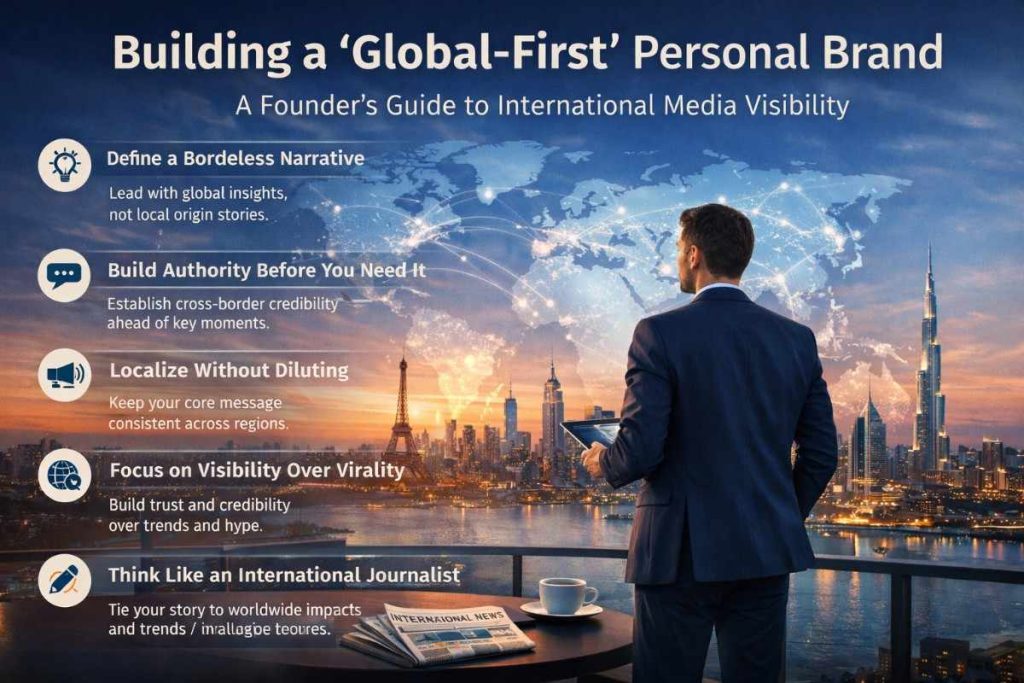
Understanding how international journalism works is critical to sustaining that relevance. Global newsrooms are driven by context and consequence rather than corporate milestones. Journalists look for founders who can speak to broader trends, explain complex shifts in plain language and offer informed perspectives beyond their own companies. Those who succeed in this environment position themselves not merely as entrepreneurs, but as credible interpreters of change in their industries. Over time, this transforms them from one-off interview subjects into trusted voices.
Crucially, international credibility cannot be manufactured overnight. Many founders make the mistake of seeking global attention only during moments of high visibility such as funding rounds, market entries or crises. By contrast, founders who command long-term respect invest in their personal brands well before they need them. They contribute thoughtful commentary, engage in global conversations and build a public track record of insight and consistency. When pivotal moments arrive, the groundwork has already been laid.
Maintaining coherence across markets while respecting local nuance is another defining challenge. A global-first personal brand does not change its core message from region to region, but it does recognize that audiences ask different questions. What resonates with media in the United States may differ from the priorities of European or Asian outlets. The most effective founders understand these distinctions and adapt their emphasis without compromising their values. This ability to localize without diluting credibility is often what separates respected global leaders from fleeting international headlines.
Visibility, however, must be handled with restraint. In an age of constant commentary and rapid news cycles, global influence is built on judgment as much as presence. Founders who chase attention through provocation or overexposure may achieve short-term recognition, but they rarely earn lasting trust. International audiences and journalists alike tend to value consistency, clarity and a willingness to engage seriously with difficult issues. Knowing when to speak—and when not to—has become an essential leadership skill.
As personal brands scale globally, so do the risks. Misinterpretations, cultural missteps and reputational crises can escalate quickly across borders. For this reason, globally visible founders increasingly treat media literacy as a core competency. Preparation for international interviews, a clear understanding of geopolitical sensitivities and a structured approach to crisis communication are now part of responsible leadership. This is less about controlling the narrative than about being ready to engage with it intelligently.
Over time, a successful global-first personal brand evolves beyond media coverage. Founders who sustain international visibility often find themselves influencing policy discussions, advising institutions and shaping the future direction of their industries. Their names become associated not just with companies, but with ideas and long-term vision. At that stage, media attention follows naturally, driven by relevance rather than promotion.
In a world where perception travels as fast as innovation, founders cannot afford to leave their personal brands to chance. Building a global-first presence requires intention, patience and a deep understanding of how stories move across borders. For founders with international ambition, the task is not simply to be seen everywhere, but to be understood everywhere—on their own terms.
Add economicedge.in as preferred source on google – Click Here
Last Updated on: Tuesday, January 27, 2026 11:08 am by Economic Edge Team | Published by: Economic Edge Team on Tuesday, January 27, 2026 11:08 am | News Categories: Startup, Trending
About The Author