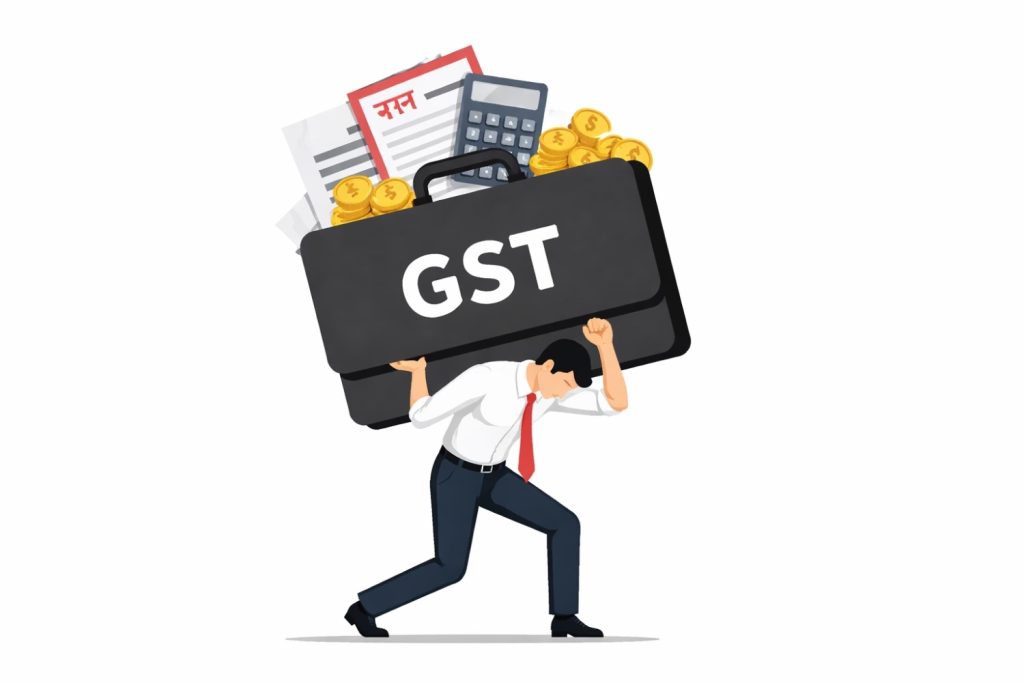
Congress leader Rahul Gandhi has reignited the GST debate, saying the current tax structure places pressure on India’s small businesses and traders.
The national debate over the Goods and Services Tax (GST) has returned to the political spotlight after Congress leader Rahul Gandhi criticised the current tax structure, claiming it is placing an unfair burden on India’s small businesses and traders.
The remarks come as discussions on tax reforms gain momentum in political circles and among business groups. The Goods and Services Tax, introduced in July 2017, was designed to simplify India’s complex indirect tax system. However, criticism from opposition leaders and some small business organisations continues to surface over compliance challenges and multiple tax slabs.
Rahul Gandhi’s latest comments have once again triggered a wider political and economic discussion on whether the GST framework needs changes to better support small enterprises across the country.
Rahul Gandhi Criticises GST Structure
Speaking during a recent public interaction, Rahul Gandhi argued that the existing GST framework has created difficulties for small and medium-sized enterprises.
He said the tax system, which was originally presented as a “One Nation, One Tax” reform, has instead evolved into a multi-layered system with several tax slabs. According to him, this structure can be complicated for smaller businesses to understand and manage.
Gandhi said compliance requirements, digital filing processes, and frequent changes in tax rules have made it challenging for small traders and manufacturers.
The Congress leader has previously used the phrase “Gabbar Singh Tax” to criticise GST during earlier political campaigns, arguing that the tax framework places a heavy compliance burden on small businesses.
While the government has consistently defended GST as a major economic reform, Gandhi’s remarks have once again brought the issue back into public debate.
What Is the GST and Why It Was Introduced
The Goods and Services Tax (GST) is India’s unified indirect tax system that replaced several central and state taxes.
Before GST was introduced, businesses had to deal with multiple taxes such as excise duty, service tax, Value Added Tax (VAT), central sales tax, and various local levies.
These taxes were often applied at different stages of production and distribution, which increased costs and created complexity in the system.
GST was introduced on July 1, 2017, after the passage of a constitutional amendment and approval by Parliament and state legislatures. The goal was to create a single national market, reduce cascading taxes, and improve transparency in tax collection.
The reform is administered by the GST Council, a federal body that includes representatives from the central government and all state governments.
Understanding the Current GST Slabs
One of the main points of debate around GST is the presence of multiple tax slabs.
India currently follows a tiered GST rate structure that includes 0 percent, 5 percent, 12 percent, 18 percent, and 28 percent tax rates.
Essential goods such as basic food items are taxed at 0 percent, while mass-consumption products are generally taxed at 5 percent.
Many goods and services fall under the 18 percent bracket, which is considered the standard GST rate. Luxury goods and certain products considered harmful, such as tobacco and some vehicles, fall under the 28 percent slab.
Some items also attract an additional compensation cess.
Critics argue that the presence of several tax slabs increases complexity in compliance and accounting, especially for small businesses.
Supporters of the system say the multiple slabs help ensure that essential goods remain affordable for consumers.
Impact on Small Businesses and Traders
Small businesses form the backbone of India’s economy. Micro, Small and Medium Enterprises (MSMEs) play a major role in employment, manufacturing, and local trade.
Many small traders have said that adapting to digital tax filing and compliance requirements has been challenging, particularly in the early years after GST implementation.
Some of the issues raised by business groups include frequent return filing requirements, the need for digital record keeping, and challenges in managing input tax credit rules.
These issues can be harder for smaller businesses that may not have dedicated accounting teams.
At the same time, the government has introduced several measures to make the system easier for small enterprises.
Government’s Position on GST
The central government maintains that GST has strengthened India’s tax administration and improved compliance.
Officials say the system has helped remove multiple layers of taxation and created a unified market across states.
Another key point highlighted by policymakers is the steady rise in monthly GST collections, which reflects stronger tax compliance and economic activity.
The government has also introduced relief measures for small businesses, including the GST composition scheme, which allows smaller taxpayers below a certain turnover threshold to pay tax at lower rates with simpler filing requirements.
These measures were introduced to reduce the compliance burden for smaller firms.
Role of the GST Council
The GST Council plays a crucial role in shaping the tax system.
The council is chaired by the Union Finance Minister and includes finance ministers from all states. Decisions are taken through discussions and voting between the centre and states.
Since GST was introduced, the council has held numerous meetings to adjust tax rates, simplify procedures, and respond to concerns raised by industry groups and businesses.
Over time, GST rates have been reduced on several goods and services following these discussions.
Experts note that GST reforms are an ongoing process and that adjustments are expected as the system matures.
Political Debate Around GST
Although GST was initially passed with wide political support in Parliament, it has increasingly become a topic of political debate.
Opposition parties argue that the system should be simplified further to reduce compliance pressure on small traders.
The ruling government has defended the reform as one of the most significant economic changes in independent India.
Rahul Gandhi’s remarks have added fresh momentum to this debate, particularly on the question of whether GST should move towards fewer tax slabs.
Calls for GST Simplification
Several economists and industry organisations have suggested simplifying the GST rate structure.
One commonly discussed proposal is reducing the number of tax slabs, which could make compliance easier and reduce confusion in product classification.
Some experts have also suggested further improvements in digital systems and clearer tax guidelines for businesses.
However, any major change to GST requires approval from the GST Council, which means both the central government and state governments must agree.
Why the GST Debate Matters
The discussion around GST is important because tax policy directly affects businesses, consumers, and economic growth.
India’s small businesses employ millions of people and contribute significantly to manufacturing and services.
Policies that influence their operational costs, compliance requirements, and working capital can have broader effects on employment and economic activity.
At the same time, tax revenue is critical for funding government programmes, infrastructure projects, and welfare schemes.
The Road Ahead for GST
Nearly nine years after its introduction, GST continues to evolve as policymakers review its performance and consider possible improvements.
Experts say the long-term success of GST will depend on simplifying compliance procedures, improving digital infrastructure, and ensuring that tax policies remain predictable for businesses.
The renewed debate sparked by Rahul Gandhi’s comments reflects a larger national discussion about how India’s tax system should balance efficiency, fairness, and economic growth.
As policymakers continue to examine possible reforms, GST is likely to remain a central issue in India’s economic and political conversation in the years ahead.
Disclaimer: The information presented in this article is intended for general informational purposes only. While every effort is made to ensure accuracy, completeness, and timeliness, data such as prices, market figures, government notifications, weather updates, holiday announcements, and public advisories are subject to change and may vary based on location and official revisions. Readers are strongly encouraged to verify details from relevant official sources before making financial, investment, career, travel, or personal decisions. This publication does not provide financial, investment, legal, or professional advice and shall not be held liable for any losses, damages, or actions taken in reliance on the information provided.
edited by D Rishidhar
Last Updated on: Saturday, March 7, 2026 8:05 pm by Economic Edge Team | Published by: Economic Edge Team on Saturday, March 7, 2026 8:05 pm | News Categories: Business
About The Author