
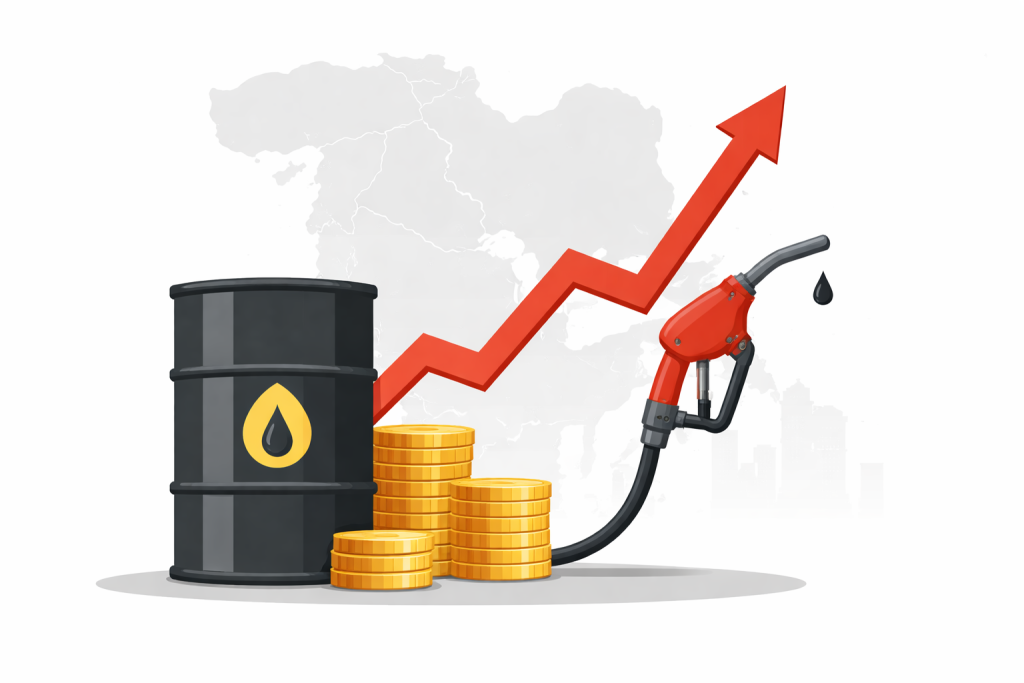
Indian stock markets fall sharply as rising global oil prices and geopolitical tensions weigh on investor sentiment.
India’s stock markets came under strong selling pressure as global uncertainty and rising crude oil prices shook investor confidence. The benchmark BSE Sensex fell more than 800 points during trading, while the Nifty 50 also slipped sharply, reflecting a cautious mood across financial markets.
The decline comes at a time when oil prices are rising and geopolitical tensions in the Middle East are escalating, creating concerns about inflation, trade disruptions, and global economic stability. For a country like India, which imports most of its crude oil, higher prices can quickly affect inflation, corporate earnings, and government finances.
Market analysts say the recent drop in equities shows how closely Indian markets are linked to global developments. Even small shifts in energy prices or international politics can influence investor behaviour.
Why the Market Fall Matters for Investors
The fall in the Sensex is significant because the index represents 30 of India’s largest and most actively traded companies. When the benchmark drops sharply, it usually reflects broader selling across sectors.
During the latest session, several heavyweights across banking, information technology, and energy stocks saw declines. Foreign institutional investors also remained cautious as global risk sentiment weakened.
Short-term volatility is not unusual in equity markets. However, when it is linked to global factors such as oil price spikes and geopolitical risks, the impact can spread quickly across sectors.
For retail investors and long-term market participants, the key question now is whether the correction is temporary or part of a larger global trend.
Rising Oil Prices Add Pressure on the Economy
One of the biggest reasons behind the recent market weakness is the sharp rise in global crude oil prices.
Oil prices have been moving higher due to supply concerns and growing geopolitical tensions. Energy markets are reacting to uncertainty in key oil-producing regions, which could disrupt supply chains.
For India, the impact is direct. The country imports more than 80 percent of its crude oil needs, making it highly sensitive to price movements.
When crude oil becomes expensive:
• Fuel costs increase
• Transport costs rise
• Inflation pressures build
• Corporate margins can shrink
All these factors can reduce investor confidence in the stock market.
Higher crude prices also put pressure on the Indian rupee, which can weaken when oil imports become more expensive.
Global Tensions Trigger Risk-Off Mood
Apart from energy prices, global geopolitical developments are also affecting investor sentiment.
Recent escalation in tensions in parts of the Middle East has raised concerns about potential disruptions to oil supply routes and trade flows. Markets around the world often react quickly to such developments.
Investors typically move money into safer assets like gold or government bonds during periods of geopolitical uncertainty. This shift is known as a risk-off trend, and it often leads to declines in equity markets.
Indian equities, like other emerging market stocks, tend to experience stronger volatility when global investors reduce risk exposure.
Banking and IT Stocks Face Selling Pressure
The latest decline in the Sensex was led by selling in several key sectors.
Banking stocks, which carry a large weight in the index, saw declines as investors booked profits after recent gains. Private sector banks and financial companies were among the stocks under pressure.
Information technology stocks also weakened. IT companies depend heavily on global demand, especially from the United States and Europe. When global economic risks increase, investors often turn cautious on export-oriented sectors.
Energy and metal stocks also reacted to global commodity price movements.
Despite the fall, analysts note that the broader fundamentals of many Indian companies remain stable.
Foreign Investors Turn Cautious
Foreign institutional investors (FIIs) play a major role in Indian equity markets. Their investment decisions can influence market direction in the short term.
When global risk rises, FIIs often reduce exposure to emerging markets. This can trigger selling pressure in benchmark indices.
In recent sessions, foreign investors have been closely watching global developments, especially oil prices and interest rate expectations in major economies.
If global tensions continue, FII flows could remain volatile.
However, domestic institutional investors such as mutual funds and insurance companies have continued to provide some support to the market.
Impact on the Indian Economy
The fall in stock markets is not just about investor sentiment. It can also reflect broader economic concerns.
Higher oil prices can lead to:
• Increased inflation
• Higher government subsidy costs
• Pressure on fiscal balance
• Reduced consumer spending
If inflation rises sharply, the Reserve Bank of India (RBI) may face additional pressure when deciding future monetary policy.
However, economists note that India’s economy remains relatively resilient compared with many global peers.
Strong domestic consumption, government infrastructure spending, and stable banking systems continue to support growth.
What Market Experts Are Watching Next
Investors and analysts are now closely monitoring several global and domestic factors that could influence the next market move.
One key factor is the trajectory of crude oil prices. If prices stabilize or decline, markets could recover quickly.
Another major factor is the evolution of geopolitical tensions. Any signs of easing conflict could improve global risk sentiment.
Investors are also watching inflation data and central bank signals from major economies, including the United States.
Global interest rate expectations often influence capital flows into emerging markets like India.
Domestic Factors Still Support Long-Term Growth
Despite the current volatility, many analysts remain optimistic about the long-term outlook for Indian equities.
India continues to be one of the fastest-growing large economies in the world. Corporate earnings have remained steady in several sectors, and domestic investment activity is strong.
Government spending on infrastructure and manufacturing is expected to support economic expansion over the coming years.
In addition, rising participation from retail investors and systematic investment plans (SIPs) in mutual funds has created a stronger domestic investor base.
This domestic participation has helped cushion the impact of foreign investor outflows during periods of global stress.
How Investors Should View the Current Volatility
Market corrections linked to global developments are not unusual. Experts often advise investors to focus on long-term fundamentals rather than short-term price movements.
Diversification, disciplined investing, and long-term strategies remain important during periods of market volatility.
Investors should also monitor macroeconomic indicators such as inflation, currency movement, and energy prices, which can influence market direction.
While global tensions and oil prices are creating uncertainty today, markets often stabilize once risks become clearer.
For now, the Sensex decline of more than 800 points reflects caution rather than panic. Investors are reassessing global risks and adjusting their portfolios accordingly.
The coming weeks will be crucial in determining whether Indian markets recover quickly or continue to face pressure from global developments.
Disclaimer: The information presented in this article is intended for general informational purposes only. While every effort is made to ensure accuracy, completeness, and timeliness, data such as prices, market figures, government notifications, weather updates, holiday announcements, and public advisories are subject to change and may vary based on location and official revisions. Readers are strongly encouraged to verify details from relevant official sources before making financial, investment, career, travel, or personal decisions. This publication does not provide financial, investment, legal, or professional advice and shall not be held liable for any losses, damages, or actions taken in reliance on the information provided.
edited by D Rishidhar Reddy
About The Author