
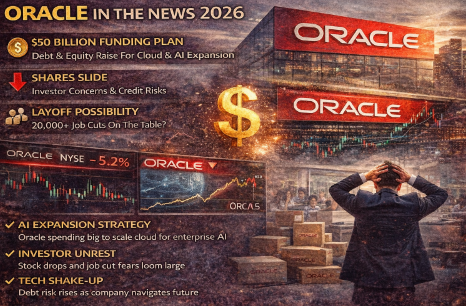
Austin, USA — Oracle Corporation (NYSE: ORCL), one of the world’s largest enterprise software and cloud services companies, has dominated technology headlines in early 2026 as it embarks on one of the most significant business realignments in its recent history. The company’s ambitious funding plan, AI-centered strategy, investor unease and potential large-scale layoffs are all influencing its market performance and corporate narrative.
Massive Capital Raise for Cloud and AI Expansion
Oracle announced a major financing initiative for 2026, planning to raise between $45 billion and $50 billion through a mix of debt and equity to support the rapid expansion of its Oracle Cloud Infrastructure (OCI) and associated AI services. Under the plan, roughly half of the funding will come from equity-linked and common equity issuances, including an at-the-market program of up to $20 billion, with the rest from a one-time issuance of investment-grade senior unsecured bonds.
The company stressed that the funds will help build additional capacity for its largest OCI customers, including major partners such as AMD, Meta, NVIDIA, OpenAI, TikTok and xAI. However, investor concerns about rising debt levels and Oracle’s reliance on AI-infrastructure deals have amplified market scrutiny.
Investor Reaction and Stock Performance
Despite the strategic intent, Oracle’s stock has been under pressure in recent months, with shares declining sharply from their late-2025 highs. Multiple market reports show that the stock has fallen significantly from peaks seen in 2025, as investors weighed the company’s hefty AI spending plans against shorter-term financial returns.
Concerns over credit and debt risk have also been reflected in Oracle’s cost of insuring its debt, which hit multi-year highs, signaling growing unease among credit investors about the company’s ability to finance its aggressive infrastructure build-out.
Analysts have pointed out that while Oracle’s cloud business continues to grow — driven by strong demand for AI compute and enterprise services — the timing and scale of capital outflows could continue to dampen sentiment until revenue from AI data centres and long-term contracts materializes.
Layoffs and Workforce Restructuring on the Table
Another headline theme is Oracle’s potential workforce reductions. Multiple reports suggest the company is considering slashing between 20,000 and 30,000 jobs globally — a possible increase from the approximately 10,000 layoffs implemented in late 2025 — to free up capital for cloud and AI investments.
Investment bank TD Cowen notes that these cuts could generate $8 billion to $10 billion in cash flow that can be redirected toward funding AI data centre capacity, a reflection of investor pressure and the high cost of data infrastructure build-out. Some analysts have also raised the possibility that Oracle could divest non-core assets, such as its healthcare software unit Cerner, to loosen fiscal constraints.
While Oracle has not formally confirmed a specific layoff figure, such a strategic shift would be among the largest workforce reductions in its modern history and is consistent with broader trends at major tech companies restructuring to accommodate rapid AI-driven change.
Strategic Focus: AI, Cloud and Long-Term Growth
Long-term, Oracle’s strategy centers on turning its OCI business into a leading infrastructure platform for enterprise AI workloads — a market that has attracted intense competition from hyperscalers such as AWS, Azure and Google Cloud. Demand for high-performance compute resources continues to escalate as generative AI applications proliferate across industries.
Oracle has already secured multi-billion-dollar contracts with large AI players, including a major agreement with OpenAI that could require substantial compute spending over the next several years. These contract commitments helped justify part of the capital-raising strategy, even as some investors remain cautious about Oracle’s long-term financing risks.
Industry analysts match mixed sentiment: some argue that Oracle’s cloud expansion and AI focus position it for future growth, while others stress that the company must balance its heavy infrastructure costs with profitability and cash-flow stability.
What This Means for Markets and Tech Sector
Oracle’s latest moves underscore a broader theme in the technology sector: the immense cost of building and operating AI infrastructure, and the strategic shifts companies must make to stay competitive. Its capital plans and restructuring initiatives could serve as a bellwether for other large enterprises navigating similar technology transitions.
Investors and market watchers will be focused on how Oracle executes its funding strategy, manages its debt profile, and balances growth with shareholder returns in 2026. The tension between long-term strategic investment and short-term financial discipline will be a critical story to follow for both Oracle and the wider cloud/AI investment narrative.
Summary
Oracle’s position in tech news today is defined by a rare and bold financing plan ($45–50 billion) aimed at scaling cloud and AI infrastructure, significant share price volatility due to investor uncertainty, and the prospect of large-scale layoffs as part of funding strategies. While the company pushes forward in a competitive AI landscape, its balance of growth ambitions and financial discipline continues to shape market perception in 2026.
About The Author